
 EN
EN
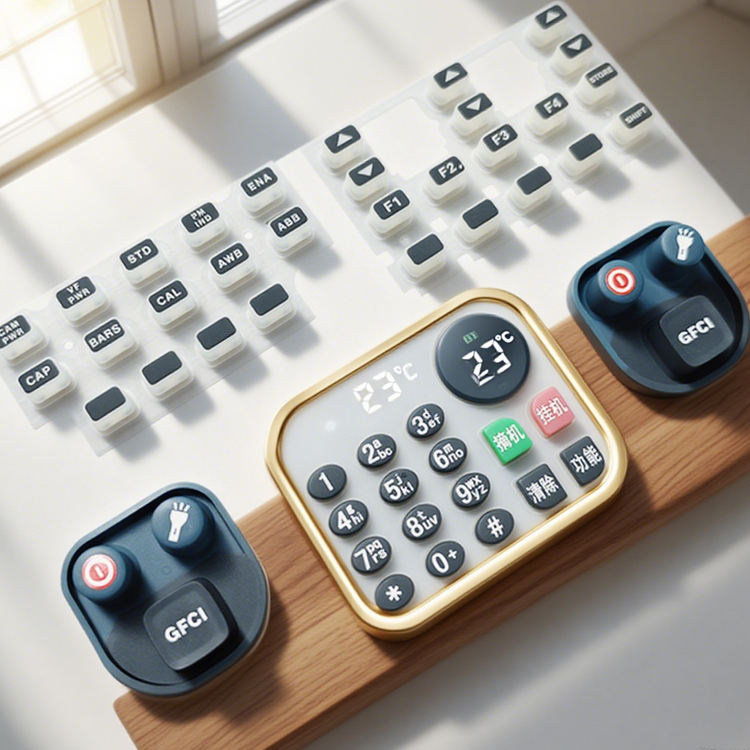
Applications in Consumer Electronics and Industrial Machinery
Remote Controls and Household Appliances
Universal Multi-Use Silicone Keypads provide reliable interfaces for everyday devices like TV remotes and kitchen appliances. Their tactile responsiveness and spill-resistant design ensure consistent performance in high-use scenarios, while slim profiles enable integration into compact smart home devices.
Fitness Trackers and Wearable Technology Interfaces
In wearable tech, silicone keypads offer sweat-resistant actuation and ergonomic button layouts. Their flexibility supports curved surfaces on fitness bands and health monitors, maintaining responsiveness across millions of input cycles—a critical feature for devices tracking real-time biometric data.
Industrial Machinery Control Systems and HMI Integration
These keypads excel in industrial Human-Machine Interfaces (HMIs), where durability meets precision. A 2024 Industrial Automation Report highlights their adoption in CNC panels and PLC systems, where chemical-resistant silicone withstands harsh workshop environments while delivering precise feedback for operator inputs.
Performance in Rugged and Extreme Operational Environments
From oil rig dashboards to military communications gear, universal silicone keypads maintain functionality in temperatures ranging from -40°C to 200°C. Their IP68-rated seals prevent dust and moisture ingress, outperforming rigid alternatives in vibration-heavy settings like agricultural machinery and construction equipment.
Durability and Environmental Resistance of Universal Multi-Use Silicone Keypad
Waterproof, Chemical-Resistant, and Dustproof Performance
Silicone keypads designed for multiple uses typically reach IP67 ratings or better, meaning they can handle being submerged in water for extended periods and still function after contact with harsh chemicals. The material itself doesn't absorb liquids because it has no pores, and it holds up well against things like oil spills, solvent damage, and regular cleaning products without breaking down over time. When manufacturers create these keypads using seamless molding techniques, there are no spaces left between individual keys and the main body of the device. This makes them completely sealed against dust particles, which is why they work so well in places where dust is everywhere, like on construction sites or inside mines where fine particulates would quickly destroy standard equipment.
Long-Term Reliability Under Repeated Use and Mechanical Stress
Silicone has this amazing ability to bounce back after being pressed, which means it can keep working properly for over a million presses. That's actually more than twice as long as those plastic keypads we see failing all the time around 250,000 to 500,000 presses. What makes silicone so special is how it spreads out the pressure when someone hits it repeatedly. This helps protect the parts where the keypad connects to other components, especially important for devices used constantly throughout the day. According to research published last year in an industrial controls journal, silicone keypads kept their performance pretty much steady too. After sitting through 18 straight months of non-stop tapping in car manufacturing plants, these silicone buttons only showed less than 2% change in how hard they needed to be pressed. Pretty impressive for something that gets used so much!
UV, Ozone, and Temperature Resistance for Indoor and Outdoor Deployment
These keypads can handle temperatures ranging from minus 40 degrees Celsius all the way up to 200 degrees Celsius. They won't get brittle when it's freezing cold outside, nor will they melt away in really hot conditions. The materials used in their construction are UV stable so they don't turn yellow or crack after sitting in direct sunlight for long periods. Plus, they stand up well against ozone exposure which makes them last longer in places like heating ventilation systems and medical sterilization units where such issues commonly occur. Recent industry surveys from 2024 show that because of this robustness against various environmental factors, most manufacturers no longer need to produce different versions for indoor versus outdoor use across nearly nine out of ten applications.
Lifespan Comparison: Silicone vs. Plastic Keypads in High-Frequency Applications
| Performance Metric | Silicone Keypad | Plastic Keypad |
|---|---|---|
| Average lifespan | 7–10 years | 2–3 years |
| Temperature tolerance | -40°C to 200°C | -20°C to 80°C |
| Chemical resistance | 45+ solvents | 12–18 solvents |
| Actuation cycles | 1M+ | 500K |
Cross-industry material studies (2024) show that silicone keypads reduce replacement costs by 62% in high-use applications such as factory controls and medical devices, justifying their initial investment.
Tactile Performance and User Interface Advantages
Engineered tactile feedback for precise user input
Universal Multi-Use Silicone Keypads deliver controlled haptic responses through integrated dome-switch mechanisms, allowing users to confirm inputs without visual verification. A 2025 Frontiers in Neuroscience study found that simulated texture feedback improves input accuracy by 18% in low-visibility environments compared to rigid interfaces, making them ideal for medical and automotive controls.
Quiet operation and consistent response vs. rigid keypads
Thanks to silicone’s viscoelastic properties, these keypads dampen audible clicks while maintaining an actuation force of 150–300gf consistently over more than 1 million cycles. This quiet, predictable response is essential for laboratory instruments and household appliances used during nighttime hours.
Ergonomic benefits in consumer and industrial user interfaces
Contoured key surfaces reduce finger fatigue by 27% compared to flat plastic keys during extended data entry. Hydrophobic coatings preserve tactile clarity in greasy or wet industrial environments, while the material’s flexibility allows OEMs to design curved control panels that conform to handheld tools or wearable device shapes.
Customization Options and Design Flexibility for Silicone Keypads
Tailored shapes, sizes, and actuation forces for diverse applications
Universal multi-use silicone keypads can be molded into geometries ranging from compact buttons under 10mm in diameter to large industrial control arrays. Actuation forces are adjustable between 150–400gf, with dome collapse points calibrated within ±15% tolerance to meet specific requirements across medical, automotive, and industrial systems.
Pad printing and laser etching for durable labeling and branding
Pad printing offers a cost-effective method for applying alphanumeric labels, while laser etching provides permanent markings that endure over 500,000 actuations. UV-resistant inks remain legible after exposure to 1200 lux of UV light, and laser-etched symbols retain contrast following ISO 9022-12 sand/dust resistance testing.
Backlighting integration (LEDs, light pipes) for low-light usability
With light transmission rates of 65–78%, silicone membranes allow uniform backlighting through 0.8mm-thick layers using embedded LEDs or light pipes. Microprismatic surface texturing and optimized diffusion layers reduce power consumption by 25% compared to traditional membrane switches.
Material coloring and aesthetic customization for OEM branding
Pantone-matched coloring ensures brand consistency with ΔE <1.5 color variance across production runs. Dual-shot molding enables multicolor designs without post-processing, and antimicrobial additives—tested to ISO 22196—can be combined with pigments to meet hygiene standards in healthcare and food service equipment.
Frequently Asked Questions
What are the temperature limits that silicone keypads can withstand?
Silicone keypads can function in temperatures ranging from -40°C to 200°C.
How do silicone keypads improve user input accuracy?
Silicone keypads use haptic responses through dome-switch mechanisms to enhance input precision by 18% as per studies conducted in low-visibility environments.
Are silicone keypads suitable for outdoor use?
Yes, due to their UV and ozone resistance, silicone keypads are ideal for both indoor and outdoor settings without the need for alternate variations.